← Home · Ground improvement

Vibrocompaction Design in Levis: Ground Improvement You Can Count On

Together, we solve the challenges of tomorrow.

LEARN MORE →

The 2015 National Building Code of Canada (NBCC 2015) sets strict seismic standards, and in Levis the post-glacial Champlain Sea sediments make those standards non-negotiable. Loose silty sands and uncontrolled fills sit across much of the south shore, leaving no margin for guesswork. Our vibrocompaction design service ensures the ground beneath your project meets the densification targets required by the CSA A23.3 standard before a single footing is poured. We map the target grid, specify vibrator power and probe spacing, and validate the results with post-treatment CPT testing that confirms the improvement depth and uniformity. Everything is calibrated to the local stratigraphy, from the compact till at the base of the bluffs to the softer lenses near the Saint Lawrence lowlands.

A vibrocompaction grid designed without site-specific CPT baselines is just a guess. In Levis we design against a measured N-value, not a textbook assumption.

Process and scope

Levis grew fast after the 1960s, when the suburban push from Quebec City spread across the bridges into old farmland and backfilled ravines. Much of the commercial strip along Route des Rivières and the newer industrial parks near the Jean Lesage airport sits on engineered fill that was never compacted to modern standards. That history shows up in the borehole logs every time, and it explains why a vibrocompaction design calibrated to local grain-size curves works better than a generic deep-densification spec. We build the treatment plan around the fines content we measure in the lab: when the passing #200 sieve stays below 15 percent, standard depth vibrators with water flushing typically achieve 70 percent relative density or better. Above 15 percent fines we often shift to a combined approach, layering compaction with drainage paths so pore pressures don't lock up during shaking. The end result is a subgrade that doesn't surprise you when the first big rain hits the open excavation.
Vibrocompaction Design in Levis: Ground Improvement You Can Count On
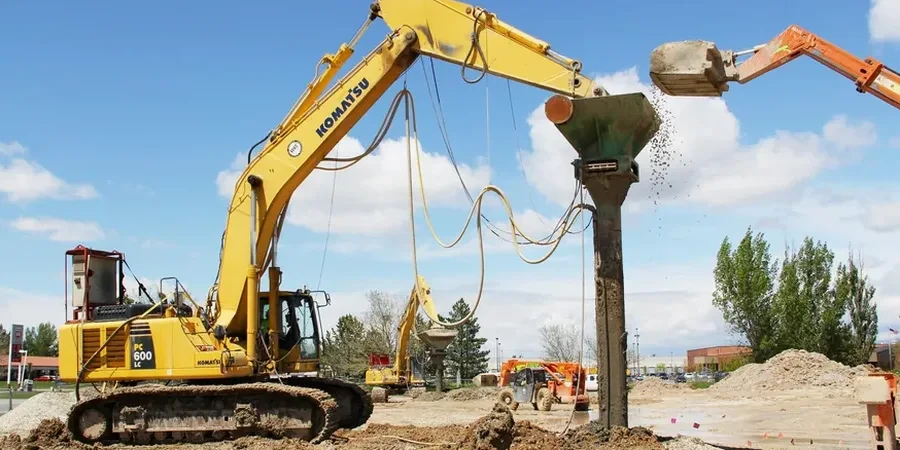
Technical reference image — Levis

Local ground factors

The risk profile changes dramatically between the old residential core of Vieux-Lévis and the commercial fill zones east of Autoroute 73. In Vieux-Lévis you are often working above intact glacial till or shallow bedrock, where vibrocompaction is unnecessary and the real concern is blasting or rock excavation. Move two kilometers east toward the Saint-Nicolas industrial sector and the soil column can be 18 meters of loose alluvial sand with a water table at 3 meters. Skip the densification there and differential settlement under crane loads or heavy racking becomes a matter of when, not if. The contractor pays for it twice: once in the repair budget and again in delayed occupancy. A proper vibrocompaction design, backed by pre- and post-treatment CPT soundings, eliminates that gamble and gives the structural engineer a uniform bearing layer to work with.

Need a geotechnical assessment?

Reply within 24h.

Email: info@geotechnical-engineering.org

Technical data

ParameterTypical value
Design depth range (typical Levis projects)6 m to 22 m below grade
Target relative density (granular fill)≥ 70% (post-treatment CPT verification)
Max allowable fines content for standard dry/wet vibro≤ 15% passing #200 sieve
Probe grid spacing (preliminary)1.8 m to 3.0 m triangular pattern
Treatment area output per rig300 m² to 800 m² per shift (soil-dependent)
Post-treatment verification window24 to 72 hours after last probe pass

Related services

01

Pre-Treatment Site Characterization

Before designing the vibrocompaction grid we drill SPT boreholes and push CPT soundings to map the loose zones, water table, and fines content across the buildable area.

02

Vibrocompaction Grid Design

We specify probe type, spacing, energy level, and treatment depth, then produce stamped design drawings ready for the specialty contractor.

03

Post-Treatment Verification

CPT soundings on a predetermined grid confirm that relative density targets are met. We compare before-and-after tip resistance profiles and issue a compliance letter.

04

Settlement Monitoring and Reporting

For critical structures we install settlement plates or survey points and track movement through the first seasonal cycle, giving the owner documented performance data.

Applicable standards

NBCC 2015 (National Building Code of Canada, seismic provisions), CSA A23.3: Design of Concrete Structures (reference for ground improvement acceptance criteria), ASTM D1586 / D6066 (SPT energy measurement and practice, referenced during pre-design investigation), ASTM D5778 (CPT procedure, used for post-treatment verification), BNQ 2501-135 (Quebec geotechnical investigation standard, referenced for site characterization)

Frequently asked questions

What does vibrocompaction design cost for a typical Levis commercial lot?

For a half-acre to one-acre commercial lot in Levis, the engineering design, pre-treatment investigation, and post-treatment verification typically range from CA$2,200 to CA$7,110 depending on treatment depth and the number of CPT verification points required. The specialty contractor's mobilization and production costs are separate and quoted by the ground improvement subcontractor.

How do you confirm the soil is actually compacted after treatment?

We run CPT soundings at the same locations tested before treatment and compare the cone tip resistance profiles directly. A clear increase in qc values across the treated depth, with no soft lenses remaining, is the primary acceptance criterion. For projects where CPT access is limited we may supplement with SPT borings and relative density calculations per the energy-corrected N-value.

At what fines content does vibrocompaction stop being effective?

Experience on Levis soils shows that when the material passing the #200 sieve exceeds roughly 15 to 18 percent, the pore pressure response during vibration prevents effective particle rearrangement. In those conditions we recommend evaluating stone columns or a combined drainage-and-compaction approach rather than conventional depth vibrators alone.
Location and service area

We serve projects in Levis and surrounding areas.

View larger map