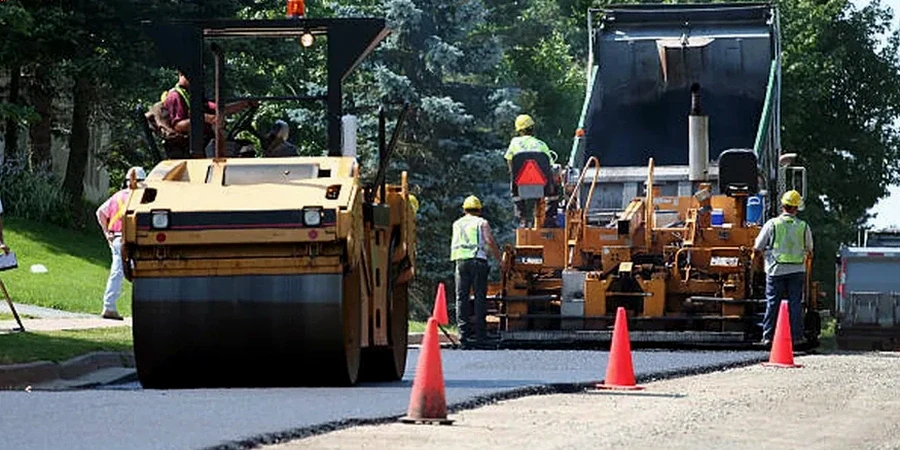
The south shore of Quebec City, including Levis, sits on a complex stratigraphy of Champlain Sea clays and glacial tills. These fine-grained soils are notoriously sensitive; when remolded, they can lose nearly all shear strength. Designing a flexible pavement here isn't just about traffic loads. The subgrade often has high moisture content and low bearing capacity, especially in spring. We incorporate this local behavior directly into the structural number calculations. For a recent arterial road in the Desjardins borough, our team correlated the design with a CBR test on site to validate the resilient modulus assumptions. The AASHTO 1993 method guides the layer thicknesses, but local calibration factors are essential in Levis.
In Levis, a pavement's failure often starts silently in the subgrade during the first spring thaw, not on the surface.
Process and scope
Southern Quebec sees over 60 freeze-thaw cycles per winter. In Levis, the frost penetration can reach 1.8 meters in exposed areas. This forces a flexible pavement design that goes far beyond standard catalogs. We specify a thick granular base, often 450 mm or more, to mitigate frost heave in the silty subgrades common near the Etchemin River. The asphalt concrete surface must resist thermal cracking, so we specify performance-graded binders, typically PG 58-34, tailored for the cold regional climate. Drainage is equally critical. Edge drains and permeable base layers prevent water from pooling under the pavement structure, which would otherwise accelerate stripping and pothole formation. An effective design also considers the aggregate source; local quarries in the Chaudière-Appalaches region produce crushed stone with specific LA abrasion values that we verify in the lab before acceptance. When we need to characterize the deeper subgrade, we often combine the pavement investigation with in-situ permeability tests to model the drainage path accurately.
FAQ
How much does a flexible pavement design for a residential street in Levis cost?
For a typical residential street in Levis, the pavement investigation and design fee ranges from CA$2,520 to CA$6,840, depending on the number of boreholes and lab tests required. This includes the geotechnical report, structural number calculation, and layer thickness recommendations.
What is the minimum granular base thickness required in Levis?
Given the frost penetration and frost-susceptible nature of the silty clays in Levis, we rarely specify less than 450 mm of granular base. The exact thickness depends on the frost susceptibility classification of the subgrade soil and the groundwater conditions at the specific site.
Which design method do you use for flexible pavements?
We use the AASHTO 1993 empirical method, calibrated with local performance data from the Quebec Ministry of Transport (MTQ). This framework allows us to correlate traffic loads, subgrade strength, and environmental factors into a reliable structural number for the pavement.
How do you account for the sensitive clay in the Levis area?
We characterize the clay's sensitivity and remolded strength through lab tests, then apply a conservative reduction factor to the subgrade resilient modulus. The pavement structure is designed to distribute loads widely, preventing the high stress concentrations that could trigger a loss of strength in the underlying sensitive clay.