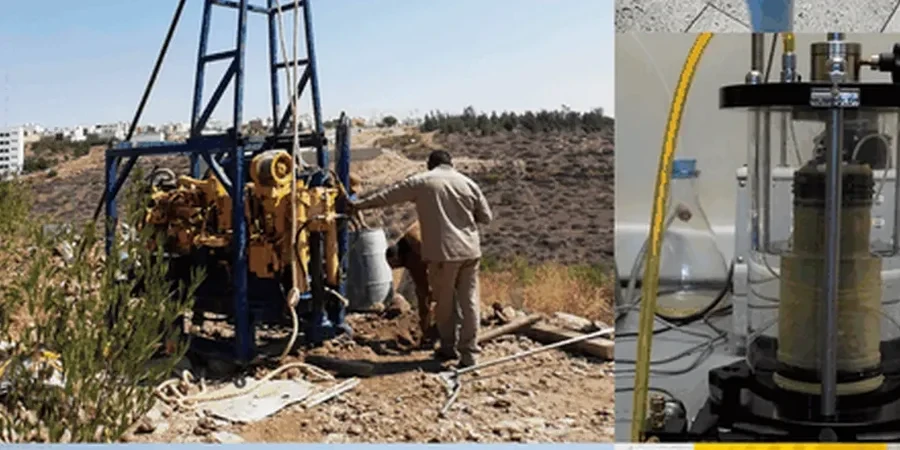
Levis sits at roughly 100 meters above the St. Lawrence River, on a terrace underlain by the Champlain Sea deposits that define so much of Quebec's south shore construction risk. We run into sensitive silty clay more often than not. A proper soil mechanics study here must quantify undrained shear strength and consolidation potential before a single footing gets sized. We have pulled Shelby tubes from Sainte-Hélène-de-Breakeyville to Desjardins and seen strength loss climb fast with disturbance. That is why our lab runs triaxial testing under backpressure saturation, matching in-situ stress conditions. If the upper crust is thin, we often pair the program with a CPT test to catch the transition into intact clay without gaps in the stratigraphic profile.
In Levis, the difference between a stiff desiccated crust and the underlying sensitive clay can be less than 50 centimeters. A soil mechanics study must capture both.
Process and scope
NBCC 2020 Division B, Part 4 governs structural design, but for Levis the real driver is Section 9.12 when dealing with the sensitive clay that underlies much of the low-lying terraces. CSA A23.3 informs the concrete exposure class, but the soil mechanics study is what delivers the allowable bearing pressure and the modulus of subgrade reaction. We measure liquidity index directly. If it sits above 1.2, the clay is quick. That changes everything. Our lab runs consolidated-undrained triaxial with pore pressure measurement on every project where the clay thickness exceeds 3 meters. We also run oedometer tests with load increments matching the final net foundation pressure plus the preload from fill. The consolidation curve tells us if secondary compression will be a problem for light structures on shallow footings. In the upper 2 meters we sometimes encounter a stiff crust left by desiccation and weathering; we quantify that crust with pocket penetrometer and unconfined compression, then verify with a few lab UU triaxials to make sure the field estimate holds.
Local ground factors
Skip the soil mechanics study and you are guessing on bearing capacity while sitting on a formation that can lose 70% of its strength when disturbed. We have seen that outcome in Levis firsthand. A contractor over-excavated into intact Champlain clay with a toothed bucket right after a rain. The bottom heaved, the adjacent road lost grade, and the fix cost more than the original foundation. Our lab can run a suite of Atterberg limits, triaxials, and oedometer tests to put numbers on that risk. We measure sensitivity—the ratio of undisturbed to remolded strength—because values above 8 mean the clay flows like liquid when remolded. In a seismic event, even a moderate one from the Charlevoix seismic zone, sensitive clay can trigger retrogressive landslides. That is not speculation; it is documented in the Saint-Jean-Vianney slide and smaller events across the Chaudière-Appalaches region. A soil mechanics study is the only way to map that hazard before the first backhoe arrives.
Standards used
NBCC 2020 – Division B, Part 4 and Section 9.12, CSA A23.3 – Design of Concrete Structures (exposure and durability), ASTM D4767 – Consolidated Undrained Triaxial Compression Test for Cohesive Soils, ASTM D2435 – One-Dimensional Consolidation Properties of Soils, BNQ 2501-092 – Soils – Determination of the Sensitivity of Clays
FAQ
How much does a soil mechanics study cost for a project in Levis?
For a complete program—including sampling, triaxial, consolidation, and index testing—the cost in Levis typically falls between CA$3,720 and CA$7,060. The spread depends on borehole depth, number of Shelby tubes, and the lab schedule. A three-borehole campaign with 6 consolidation tests will land near the upper end.
What makes the Champlain Sea clay in Levis different from other clays?
Its sensitivity. The clay was deposited in a saline post-glacial sea, then leached by freshwater, leaving a flocculated structure that collapses when remolded. We measure liquidity index and sensitivity to flag quick clay risk. Values above 1.2 for IL or above 8 for sensitivity require special foundation and excavation protocols.
Do we need triaxial testing or is unconfined compression enough?
For sensitive clay, unconfined compression alone is not enough. It gives a rough Su value but no effective stress path and no pore pressure response. We run consolidated-undrained triaxial with pore pressure measurement on samples deeper than 3 meters, and at least one per distinct stratigraphic unit.
How deep do you typically sample for a soil mechanics study in Levis?
Most residential and light commercial projects require sampling to 8–12 meters, which captures the crust, the soft sensitive clay, and the transition to till or bedrock. For taller structures or deep excavations, we extend boreholes to 20 meters or more, guided by the expected stress bulb depth.