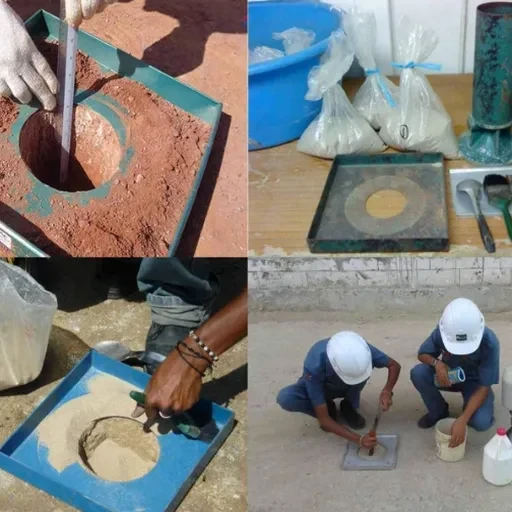
The most common call we get from Levis contractors starts the same way: the nuclear gauge failed calibration in the morning and the inspector is already on site. The sand cone method doesn't have that problem. It's mechanical, it's direct, and it's the referee test when other methods disagree. Our lab team runs ASTM D1556 procedures on granular base, trench backfill, and structural fill across the south shore, from Saint-Nicolas to Charny. We show up with calibrated sand, a pre-weighed jar, and a balance that's been checked against traceable standards within the last 24 hours. No warm-up, no battery, no radiation license paperwork. Just a hole in the ground and a measured weight of Ottawa sand. For projects where the fill material is coarse or contains oversize particles, we often recommend pairing the sand cone with a CBR test to correlate density with bearing capacity before placing pavement structure.
One sand cone test at the wrong moisture content can pass a lift that will settle in two freeze-thaw cycles.
Local ground factors
A field density test starts with a 12-inch sand cone jar, a machined aluminum cone with a valve, a metal base plate, a digging spoon, and a moisture can. That's the entire kit. The hole gets dug carefully by hand, the soil goes straight into a sealed bag, and the pre-weighed sand flows from the jar into the cavity until it's flush with the base plate. The risk in Levis isn't the equipment. It's the clay seams that run through the St. Lawrence lowlands till. A lift compacted over a wet clay lens will read fine on the sand cone but fail under load later. Our techs are trained to spot mottled soil, feel the resistance on the spoon, and flag the lift before the next one goes on top. If the material looks suspect, we stop the test and call the geotechnical engineer. No report gets issued until the observation is resolved.
FAQ
How much does a sand cone density test cost in Levis?
A single field density test with the sand cone method typically runs between CA$160 and CA$190, which includes the on-site procedure, the oven-dry moisture content, the calculation against the Proctor curve, and the stamped report issued the same day.
How many tests do I need per day of fill placement?
The standard guidance is one test per 300 cubic metres of placed material, with a minimum of one test per lift per day. For structural fill under footings or slabs, the engineer of record may tighten that frequency based on the variability of the borrow source.
What soil types can the sand cone method handle?
It works best on soils with a maximum particle size under 25 mm. Coarser material with gravel or cobbles requires a larger test hole and a different calculation using a replacement method. If the soil contains significant oversize, we discuss alternatives like the water replacement technique before mobilizing.
How long does it take to get the test result?
The field measurement and the oven-dry moisture run in parallel. We give a verbal pass/fail immediately after the dry density calculation, which takes about 20 minutes from the start of the test. The formal signed report is emailed before the end of the same working day.