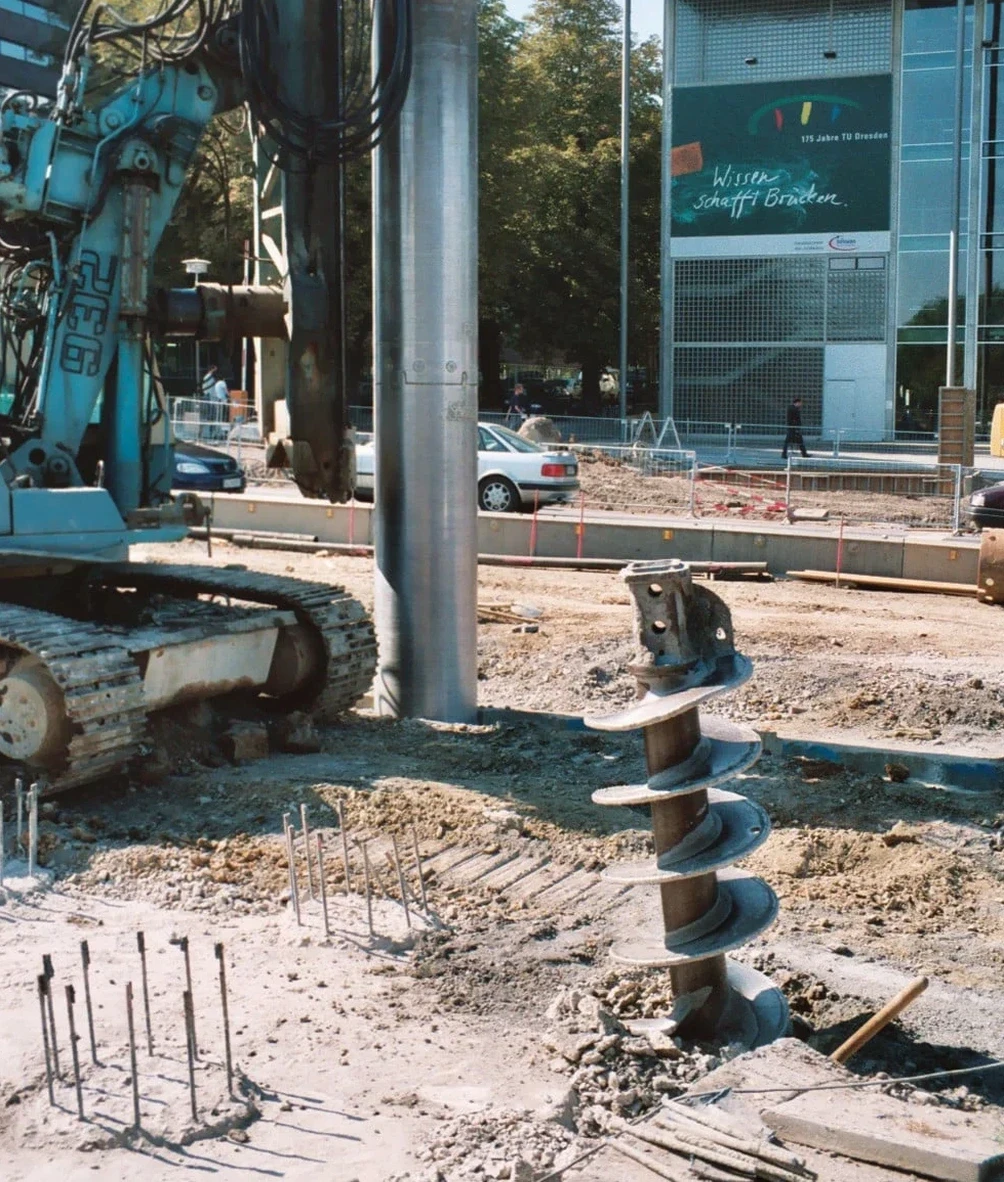
The south shore near Levis sits on Champlain Sea clay overlying glacial till and shale bedrock—a profile that varies from 4 m to over 30 m of soft, sensitive silts. With a design earthquake magnitude factored into the 2020 NBCC and a site class often falling in Class D or E, shallow footings rarely carry out the needed factor of safety. Pile foundation design becomes the core of the structural solution, whether for a riverside multi-residential project or an industrial warehouse near the Trans-Canada Highway corridor. Anchor lengths, shaft resistance in the till, and downdrag caused by consolidating clay all require detailed integration of in-situ data. Before finalizing a pile layout, many projects combine borehole data with a CPT test to map the thin sand lenses that can govern tip capacity, or use SPT drilling to correlate blow counts with undrained shear strength.
Pile design on Champlain Sea clay is not just about capacity—it is about predicting downdrag and lateral spread before the first pile is driven.
Local ground factors
Historic development in Levis spread outward from the old industrial port toward the higher terraces, often placing buildings on filled ravines or perched above buried valleys. In these zones, the pile foundation design inherits the risk of unrecorded fill thickness, variable groundwater perched on silt lenses, and lateral spreading potential during a seismic event. The 2020 NBCC spectral accelerations for the region demand a careful check on kinematic pile-soil interaction, especially where the soft clay amplifies ground motion. Ignoring the sensitivity of the Champlain Sea clay—which can lose more than 80% of its strength when remolded—leads to underestimating group settlement. A design anchored only in static load tests, without a seismic performance analysis, leaves the foundation vulnerable to the very event that governs the structural code.
FAQ
What is the typical cost range for a pile foundation design package in Levis?
For a single-family or small commercial project, the engineering design package including soil data review, axial/lateral capacity calculations, and a pile schedule drawing generally falls between CA$2,630 and CA$7,790. The range depends on the number of piles, complexity of the soil profile, and whether dynamic testing interpretation is required. Larger multi-story or industrial projects exceed this range due to additional seismic analysis and group settlement modeling.
How deep do piles typically need to go in Levis to reach competent bearing?
Depth varies significantly with location. Near the river, piles may need to penetrate 20–30 m of clay before reaching glacial till or shale. On the higher terraces south of the escarpment, bedrock can be found at less than 8 m. The pile foundation design always starts with a site-specific borehole to confirm the depth to the bearing stratum.
Which pile type is most common in Levis—driven or bored?
Both are used depending on access and noise constraints. Driven steel H-piles or closed-end pipe piles are common in open sites with thick clay. Bored cast-in-place piles are preferred in urban areas where vibration is a concern. The choice is evaluated as part of the pile foundation design, weighing installation logistics, cost, and performance in sensitive Champlain Sea clay.
Does the NBCC 2020 require seismic lateral analysis for pile design in Levis?
Yes. Levis falls within a moderate to high seismic hazard zone under NBCC 2020. A lateral load analysis using p-y springs or equivalent static methods is required for structures in Site Class D or E. The pile foundation design must demonstrate acceptable deflection and structural demand under the design earthquake, including potential kinematic interaction from soft clay amplification.