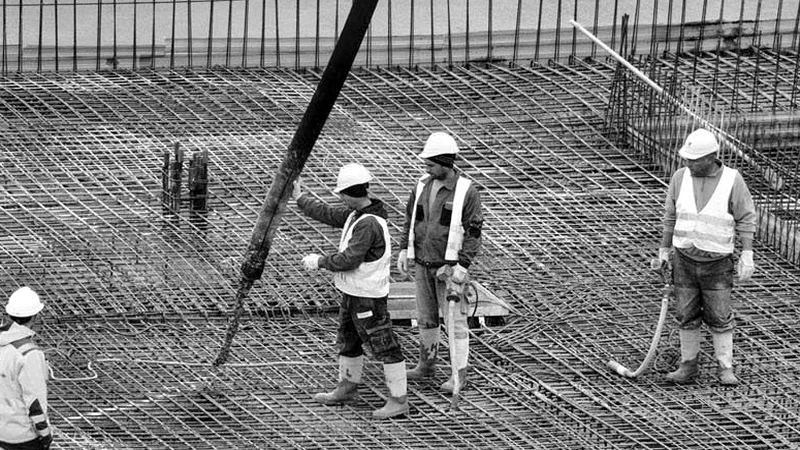
One of the most expensive mistakes we see in Levis involves contractors pouring a conventional spread footing over a pocket of sensitive clay without realizing it. The Champlain Sea left a tricky legacy across the South Shore—layers of silty clay that lose strength dramatically when disturbed. A properly sized mat foundation bridges those inconsistencies instead of fighting them. We start every design with a subgrade reaction modulus derived from field testing, not generic tables, because the stratigraphy along the St. Lawrence escarpment changes within a single lot. When the soil profile demands it, we also cross-check settlement predictions with data from CPT testing to refine the compressibility parameters before locking in the reinforcement schedule. The goal is a foundation that floats the structure evenly, even where the bearing stratum dips or varies in thickness.
A mat foundation on Champlain Sea clay works like a snowshoe—distributing weight so the structure doesn't punch through the crust into the sensitive layer below.
Local ground factors
The NBCC 2015 requires that foundations on sensitive clays be designed to prevent progressive failure—a scenario where localized yielding cascades into a bearing failure across the entire mat. In Levis, the combination of a high water table and the presence of Leda clay makes this requirement particularly sharp. If the geotechnical investigation misses a lens of quick clay, a mat foundation without adequate thickness will deflect excessively, cracking the slab and superstructure. The cost to underpin or abandon a failed raft in winter conditions, with frozen access and limited working hours, easily dwarfs the cost of a proper design. Our approach includes a sensitivity classification per the Norwegian Geotechnical Institute framework, adapted to local Champlain Sea deposits, so the structural design accounts for strain-softening behavior from the start.
FAQ
What does a mat foundation design cost for a typical Levis residential project?
For a single-family home or duplex on a standard lot, the geotechnical investigation and mat foundation design package generally falls between CA$1,580 and CA$5,400. The final figure depends on the depth to competent bearing stratum, the number of boreholes required to characterize the site, and the complexity of the reinforcement detailing. A site with uniform till at 3 meters will be at the lower end; a site requiring deep sampling through sensitive clay with groundwater monitoring will push toward the upper bracket.
How deep does the frost protection need to go in Levis?
The NBCC 2015 specifies a minimum frost penetration depth of 1.8 meters for the Levis area, which is slightly deeper than Montreal due to the colder winter regime along the St. Lawrence. The bottom of the mat must extend below this depth, typically achieved by placing the slab on a compacted granular pad that itself sits on frost-free bearing soil.
Do we need a mat foundation, or can we use conventional footings?
It depends on the soil profile. If the bearing stratum is competent till or bedrock within 1.5 to 2 meters and the loads are moderate, strip footings may suffice. A mat foundation becomes the better choice when the site has pockets of compressible clay, a high water table, or requires a basement slab anyway—combining the slab and footing into one structural element often saves concrete and forming labor.
How do you handle seismic design for a mat foundation in Levis?
We use the NBCC 2015 seismic hazard values for the Levis coordinates, factoring in site class amplification based on the shear wave velocity profile of the upper 30 meters. For mat foundations on soft clay (Site Class E), the spectral acceleration can be significantly higher than on rock, so we model the soil-structure interaction to ensure the mat has sufficient stiffness to distribute inertial forces without excessive rotation.