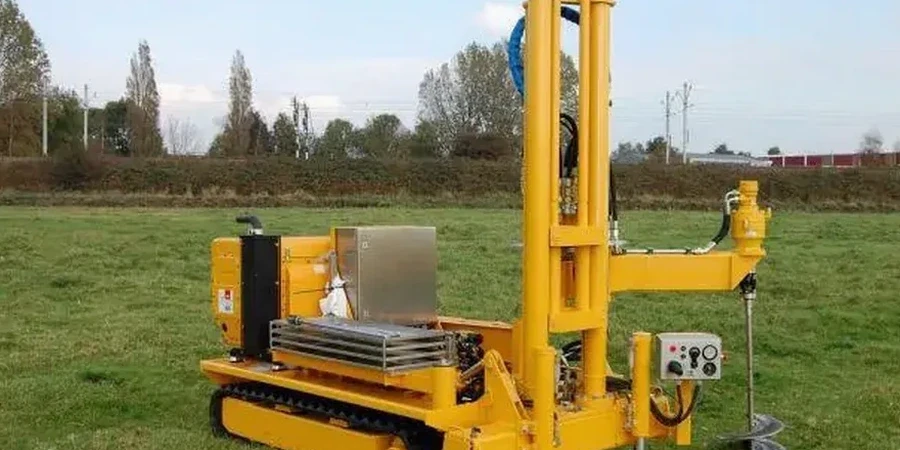
Between the dense glacial till ridges of Saint-Nicolas and the softer Champlain Sea clays underlying central Levis, the bearing behavior of subsoil shifts dramatically within just a few hundred meters. A standard borehole might miss a thin drainage lens, but the cone penetration test captures it in real time. Levis sits on the south shore facing Quebec City, with bedrock depths varying from near-surface in the Appalachian foothills to over 40 meters along the Chaudière River terraces. The CPT system records tip resistance, sleeve friction, and equilibrium pore pressure every 2 cm, producing a continuous resistivity profile that identifies interbedded silts, sensitive clays, and high-permeability lenses without sample disturbance. Our field crew deploys a 20-tonne penetrometer truck across lot sizes from 400 m² residential parcels to multi-hectare commercial zones in Desjardins, always referencing the NBCC 2020 seismic provisions and CSA-A23.3 foundation requirements. When preliminary site reconnaissance suggests a complex post-glacial sequence, the CPT run clarifies whether deep foundations or ground improvement will govern the structural design.
A single CPT sounding in Levis can replace four boreholes when the stratigraphy is laterally continuous, cutting investigation time by half.
Local ground factors
The harsh freeze-thaw cycles of the Quebec City region subject near-surface clays in Levis to annual frost penetration reaching 1.8 m below grade, yet the CPT identifies unfrozen sensitive clay layers that lose up to 90% of their undrained shear strength if remolded during excavation. Winter work on the exposed plateaus of Pintendre demands pre-heating the cone rods to prevent ice locking in the sleeve sensor, while spring runoff from the Appalachian watershed temporarily raises the groundwater table by 2 to 3 m, altering the effective stress regime mid-investigation. A pore pressure ratio Bq exceeding 0.4 during a dissipation test signals a contractive, potentially flow-liquefiable soil fabric that must be addressed before any deep excavation near the Saint-Lawrence shoreline. Omitting CPT in favor of sparse boreholes in these highly stratified glaciomarine sequences has led to differential settlement claims exceeding six figures in the Desjardins borough, a consequence of undetected soft pockets between competent till layers.
FAQ
How much does a CPT investigation cost in Levis?
Mobilization and the first 15 linear meters of penetration typically fall between CA$220 and CA$360 per meter, depending on the number of soundings, seismic module requirements, and site accessibility. A full-day campaign with 4 to 6 soundings and dissipation tests usually ranges from CA$3,200 to CA$5,400, including the factual data report in CPeT-IT format.
Can the CPT distinguish between Champlain Sea clay and glacial till in Levis?
Yes, and it does so continuously. The till returns cone resistance above 10 to 20 MPa with friction ratios below 1%, while the sensitive clay shows qc between 0.4 and 1.2 MPa and friction ratios from 1.5 to 4%. The pore pressure transducer also shows a sharp positive spike when penetrating the clay-till interface.
What is the minimum lot size for the CPT truck in Levis?
The 20-tonne penetrometer truck requires a 3.5 m wide access path and a stable working platform of roughly 8 m by 4 m. For tight residential lots in the Vieux-Lévis district where truck access is impossible, we deploy a portable crawler CPT rig that fits through a 1.2 m gate opening.
How does the CPT data affect the NBCC seismic site classification?
The shear wave velocity profile from the SCPTu module is the primary input for determining the site class (A through E) per Table 4.1.8.4.A of NBCC 2020. A Vs30 below 180 m/s places the site in Class D or E, which can double the design spectral acceleration compared to a Class C assumption, directly impacting structural costs.